BulgingButtons

Not bad for a fat girl


1 Comment

An Open Apology to Fourth Graders

Dear Fourth Graders,

On behalf of compassionate fourth grade teachers everywhere, I’m sorry.

1. I’m sorry that you don’t have as much recess time as you really need. I know that you need to run around and play more. I know that you need more opportunities to be with your peers in unstructured environments and more time to work out your conflicts without adult interference. I know that you need to exercise your imagination as well as your body, and that the short amount of time that you get to do this each day isn’t enough. I also know that your opportunities for this kind of play and social interaction outside of school are extremely limited in most cases. I’m sorry that most of you don’t live in “free range” neighborhoods, where you can ride bikes, play in friends’ yards, and feel like you own the outdoors. I’m sorry that for the most part those days are gone.

2. I’m sorry for the sad excuse that is your school lunch on a daily basis. Back in the good old days there was a delicious hot lunch waiting in the cafeteria for students each day, prepared with love by the ladies behind the counter in hairnets. I’m sorry that much of what you receive these days comes out of microwaved packages and hardly resembles a home cooked meal. Furthermore, I’m sorry that you don’t know the difference and think that it’s perfectly fine. I’m sorry that your tray is disposable and that we’re adding millions of these to landfills everyday, along with the packaging that your lunch came in. I’m sorry that your lunch time is no longer about enjoying a meal with your friends, but rather about shoving as much of this processed junk into your mouth as you can in the tiny amount of time you’re allotted. I’m sorry that these days items such as “trout treasures” are on the menu, and that someone thinks that serving cucumber slices with a pancake lunch is a good idea.

fracti83. I’m sorry about fractions. I know you don’t like them and that they’re confusing. I agree. They’re a little difficult to understand once you get past the basics, and frankly most people only really need to understand the basics. You, however, are in fourth grade, so you are expected to understand a lot more than that. You are expected to be able to identify lots of equivalent fractions, to order fractions on number lines, and to complete operations with them. You need to be able to rename them, decompose them, add them, subtract them, and mix them with whole numbers. You are also expected to be able to show multiple representations of all of these mathematical gymnastics, so relying on the old pizza diagram just doesn’t quite cut it anymore. I know that your parents have never seen the kind of work that we’re doing and that they can’t help you and they feel as frustrated by this as you do. I know it’s a lot, and I know there are umpteen million things you would rather do than draw a model of yet another fraction pair, but we have to do it. I’m sorry.

4. I’m sorry about all the tests. You think they’re normal, after all you’ve been tested half to death since before you ever set foot in a classroom, but I know the difference. Taking a TestI know that you’re tested too often, and frequently on all the wrong things. I’m required to test you reading against a stopwatch. I’m required to administer long complex tests via computer three times a year in math and reading. I’m required to make sure you’re prepared for a multi-day end of the year assessment that someone else wrote on content that I’m not convinced is even developmentally appropriate for you. Oh, and this year the test is brand new and nobody seems to have any clear idea of what it will actually be like. I’m sorry. I’m sorry it will be a surprise, and I’m sorry that it’s so darn long. I know you’re a little kid. I know that your attention span is fairly short. I know that this test is way more important to me than it is to you, and I’m sorry that I keep trying to get you to understand that I really need you to take it seriously and do your best. It should be enough that I’ve been teaching you all year and that I know what you understand and what you don’t, but unfortunately, some very powerful people don’t see it that way. I’m sorry.

5. I’m sorry that we just don’t have time for all the fun things that I know you would love, and that would help you to enjoy school and someday look back on it with fondness. I’m sorry that celebrating holidays is pretty much a thing of the past. I’m sorry that we’re so “culturally sensitive” that we end up doing virtually nothing out of the ordinary ever, for fear of upsetting someone. I’m sorry that our curriculum leaves so little room for art and drama and good old-fashioned fun. I’m sorry that we don’t do as many projects as you would like. I’m sorry that I have to rush you to learn, when I know that a slower pace with more time to process is what so many of you need. I’m sorry that I have to put my better judgement aside so frequently as a result of what I must accomplish on a daily basis. I’m sorry that room mothers (and fathers) and Valentine’s parties and time for games and crafts and show and tell have become a thing of the past in so many cases. I’m sorry that so often we don’t get to see the real you in school as a result.

6. I’m sorry that you think everything about school is as it should be. I know you would just LOVE to spend a week or two on a thematic unit studying the tropical rainforest, or that working together to make a group quilt would be a valuable and rewarding activity, but those types of learning experiences are so difficult to squeeze into the already demanding curriculum. All hope is not lost though. Your teachers really do want you to love school, so they hang on to those events and activities that they hold most dear, in hopes that we can leave some lasting impression of fourth grade, beyond tests and fractions and lousy school lunches. I’m sorry that we can’t do more of them, though.

7. I’m sorry that I only get you for one year. Fourth grade is a tough year. You’re expected to be a good reader by now, only many of you aren’t, yet. You’re expected to work independently at this age, except that many of you struggle with this expectation daily. You’re expected to be organized, but for a lot of you that’s just not possible. You’re expected to solve your own problems, except that many of you have little experience with this skill, so you’re not very good at it yet. Add to that the fractions and the testing and the quick pace and the lack of downtime, and fourth grade ends up being a very stressful time for many kids. It’s also a time when class sizes increase (at least in my district) and it’s when some children are beginning to show signs of puberty. It’s a year of challenges, but one that you’ll get through. I wish I could keep you for fifth grade. I’ve had that pleasure before, and that second year together is magic. We know each other, we work together as a team, and you do amazing things that you just weren’t quite ready to do the year before. I can’t keep you, though. I have to send you on at the end of the year, but I know you’ll be ready, and for that, I’m not sorry at all.

I know you don’t always understand why I do what I do in school, and why you have to do what you have to do, but please trust me. I’ve been doing this for a long time, and I make descisions about your education with an open mind and an open heart, within the parameters that are allowed. I care about you, and your future. After all, your future is tied to mine, and I want you to be as well prepared, in all ways, as possible.

With love,

Your Fourth Grade Teacher


2 Comments

Do’s and Don’ts of Parent Teacher Conferences

It’s conference week in my school district, which means that I’ll meet with all 31 of my students’ parents. That’s 31 conferences, right? Nope. Some parents can’t stand to be in the same room with each other so in some cases I hold separate conferences for mom and dad.

Conferences start before school, then I teach for about 5 hours, then they resume after school. Yesterday I held 14 conferences and spent twelve and a half hours at school, with about a 25 minute lunch break (that’s normal) and about a 40 minute dinner break. I have a conference scheduled to begin at 7:30 this morning, then I will do it again (but there are only 9 scheduled for today). We do this twice a year.

In between these conferences I complete and share formal progress reports for all of the students, and I make numerous phone calls as things come up for students. I’m not complaining, I’m seeking to educate.

I know that the conference time is short, in most cases around 20 minutes, but if you do the math you can see why. I also am not planning to use this time to discuss the relative merits/limitations of the curriculum. That is a separate conversation that we need to schedule for a separate time, and honestly, it’s better suited for discussion with an administrator. My district has adopted particular curriculum. As a teacher in my district I teach that curriculum. You are welcome to challenge it with the administration and even the school board if you feel strongly enough. Personally I’m not teaching anything that I feel is damaging to your children, and I am not likely to change it because you don’t particularly care for it.

One issue I’ve been hearing over and over is about the way the math is being taught. I know it’s different than when you went to school. I know it’s confusing to you and you’re frustrated that you are unable to help your child with the homework. We’ve talked about this since meet the teacher night. Your child is learning in spite of your frustration. Demonstrate some flexibility of thinking and some open mindedness,and  your child will learn from your example. Eventually she’ll be able to do the math the way you were taught. We’re just laying in some foundation work that you (and I) didn’t get in school. We really believe that it will help her understanding of math, and that she won’t attend her own children’s conferences some day announcing, as so many parents do, “I can’t do math.”

Please know that I enjoy and admire your children, but they aren’t perfect. They have quirks and behaviors that sometimes distract themselves and others from learning. I share these with you in order to enlist your support as we work to help your child learn self control and independence. I’m not picking on you or your child. I want all of my students to be at their very best and to learn as much as possible so that they can be successful in life.

Parents, I promise you, in most cases your child’s teachers are not the enemy. I’m certainly not. I work very hard to ensure that each child is getting what he or she needs, but please understand that I work with many other students in addition to yours. I offer individual attention to students every day of the school year, but I also have obligations beyond teaching. There are lesson plans to be created, work to be assessed, reports to be completed, children to be evaluated, trainings to be attended, continuing education to be completed, and so much more. I know that there are some of you who would like your child’s teacher to give up his or her 25 minute lunch or stay after school tutoring your child, but sometimes we’re simply not available. Oh, and we have families too.

What NOT to do.

What NOT to do.

If I sound like I’m ranting, I apologize. I can’t tell you how many wonderful families I have had the privilege to work with over the years, and how fantastic my current group of students and parents is. This note isn’t for those people. They’re doing everything right. Here’s how to do parent/teacher conferences (as demonstrated by some of my favorite families):

1. Be flexible with your appointment time if at all possible. Many people have difficult work schedules and multiple children in school. I really work hard to accommodate everyone’s schedules. If you don’t care what afternoon you come on, it makes scheduling a lot easier for me.

2. Come with an open mind. Try to remember that your goal and my goal are the same. We both want what is best for your child based on his or her abilities, limitations, gifts, needs, and so on. I know all students are not alike, and I work hard to help each student grow and learn.

3. Let me be the bad guy if there are issues. Yes, I want your support. Yes, I want you to hold your child accountable for his or her learning and behavior, but don’t go overboard. These are kids, and they’re your kids. Be proud of them and love on them, then correct them. Don’t let them play you, though. They’ll throw anyone under the bus if they think they’re in trouble. All kids lie. It doesn’t make you a bad parent.

4. Be prepared to leave with some homework. I’m going to enlist your help at this conference. I will suggest some things that I’d like you to try at home with your child in order to help him or her. It may be that I ask you to read aloud with him or allow her to cook with you to practice measuring and following directions. I won’t ask anything crazy of you. I want your time with your child to be loving, fun, and productive. You’re busy. I know. I’m a parent too.

5. Don’t be upset if I tell you something you don’t want to hear. Ok, be upset, but don’t be upset with me. Your child may have stopped turning in work, or may have some indications of a possible learning disability or attention issue. Your child may have been distracting others. I don’t make things up about kids. I don’t have to. If I share something that is uncomfortable or difficult, I’m sorry. I don’t enjoy sharing bad news, but I do often have ideas about how to approach whatever the problem is. Remember point two, please come with an open mind.

Want extra credit? Bring a small gift. I am always delighted and surprised when families present me with some small token of appreciation. This morning I received a tray of homemade cookies. It’s a lovely gesture that is much appreciated. Even tissues for the class are appreciated.

Tomorrow I head back for my final conference for this quarter. I get to do it all again in the spring. I’m not ready to think that far ahead. Right now I’m just plain tired.


2 Comments

The Evolution of the Report Card

Thank goodness, my report cards are done! All thirty of them, with their multitude of boxes to complete and their various test scores to enter. Then there are the STANDARDS. Math is not merely math. It’s not even number sense, geometry, and so on. It’s a long list of skills, each with it’s own value to be assigned. Oh for the good old days.

report card 1

Old school, like mom’s.

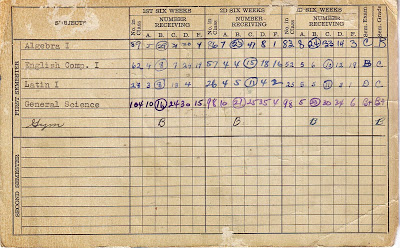
I remember seeing my mother’s report card as a child and thinking it was so small. There was hardly anything written on it. The subjects were listed along with the appropriate quarters. In the tiny boxes were numbers – 86, 94, 92, and so on. Those were mother’s grades. If she had a 78% average in math, so be it, that was her grade. Her parents would be upset and she would study harder (this is hypothetical- mother was an excellent student). There were also grades for items like handwriting, citizenship, and deportment. The teacher may have written a short comment in perfect script, but that was about it.

My own report cards were quite different. They still had all the subjects listed, but there were no numbers on the report, other than the attendance records. Everything was scored on an O/S/N basis. I had mostly O’s, for outstanding, and several S+ marks too (satisfactory, of course). N was a mark I never received. Horror, to receive a needs improvement in elementary school. My teachers wrote chipper paragraphs about how delightful I was, and they thanked my parents for sending me to school. What I wouldn’t give to do THOSE report cards!

When I started my career, our report cards were a mix of the two. We still assigned the O/S/N scores in each area, but we also gave out academic letter grades, plus a breakdown of skill abilities, which were assigned a slash, a plus, or an x.

Similar to those used early in my teaching career. Don't get me started about the misuse of the effect/affect on this document.

Similar to those used early in my teaching career. Don’t get me started about the misuse of the term effect/affect on this sample document.

Go figure. This was a complex document, and it took half of a parent/teacher conference to explain it.

Then, along came the new report cards, which were connected to the online gradebook. One might think this would be a great time saver, but one would be mistaken. Sure there are some nice features. The days of manually figuring grades are long past, and the scores automatically populate the report card, but now there are twice as many (at least) categories requiring not only some type of score, but explanation to parents. We have entered the era of the two sided report card. The slash, plus, x system has been replaced by a 1,2,3 system, that most people understand better, so that’s a positive, but there are simply too many categories.

As a parent I want to know how my child is doing overall, then how he or she is doing in each subject area. If she’s struggling in math, please tell me what I can do to help her. Should we be studying types of polygons or memorizing multiplication facts or working on subtraction word problems? That information isn’t clearly conveyed in this extensive document. What it does contain is a lot of jargon that I, as a parent, don’t really understand. It’s just too much.

In my experience, parents of fourth graders want to know a few basic things about their kids as they relate to school. 

1. Does he have friends? Most parents already know the answer to this one, but for those who aren’t sure it’s vitally important that they know.

2. Does she behave herself and do her work? This is of paramount importance, because it frames everything that comes after. Most parents want their kids to try hard and do well, but if they can’t have both they want them to try hard. Also, if a child is doing poorly, it may be that they aren’t applying themselves. If this is your child, I promise that if the little cherub would listen to the directions and then follow them, he or she would learn more and do better.

3. How is she doing in the main subject areas- reading, writing, and math? These are the cornerstones of later learning, and parents know it. They see the homework, but they often don’t have a benchmark for where their child falls in terms of their learning. They want to know if they’re doing ok.

4. How can I help him? This is a genuine heartfelt concern. Parents want to help their kids succeed. It is hardwired in most of us. They want concrete ideas and they want to be acknowledged for the things they are doing right. They may not hear it from anyone but us. Just showing up for the conference is worthy of praise, it shows commitment to education and making the child a priority.

5. Will my child be alright? Maybe she will and maybe she won’t. We have data and test scores and years of experience working with similar students, and we will do whatever it takes to get your child moving in the right direction if he or she is not currently making adequate progress. We are on your child’s side, always. Some children need a little extra encouragement, other children need a myriad of interventions to help them learn. Let’s work together to find  out what is going on and what will best help your child.

If we could design an instrument that addresses these five areas without all the extra hoopla, I think we would be doing everyone a favor. Well, everyone but the companies that profit from these overly complex reporting systems. In most cases, I want to just write, “Don’t worry Momma (or Daddy, Grandma, Aunt Debbie, or whomever is raising that child), your child is doing just fine.”