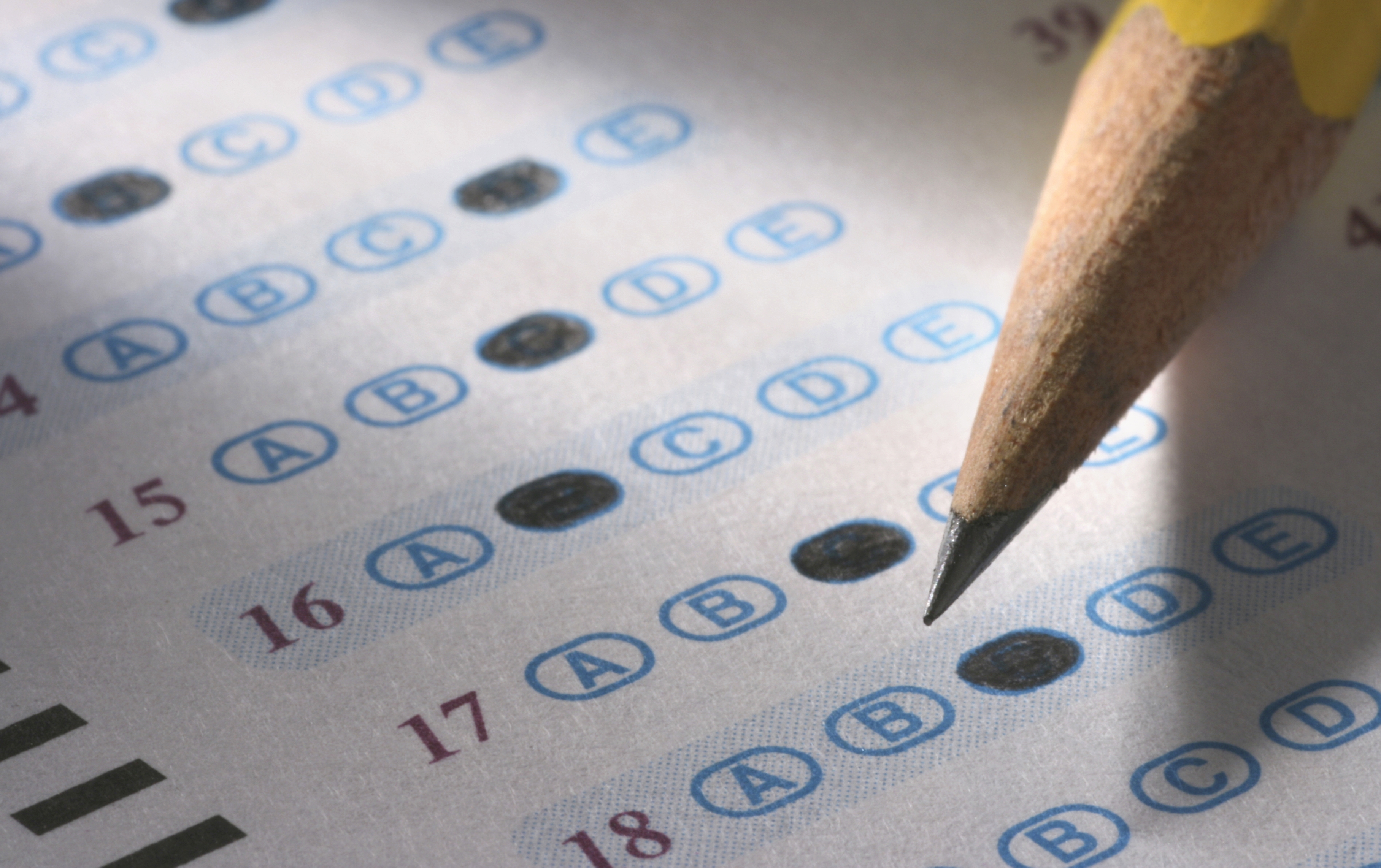
In a few hours my son will wake up and sharpen a few Number 2 pencils, then go off to take his SAT. For those of you who may be unfamiliar with this particular phenomenon, the SAT is the Scholastic Aptitude Test, and in the U.S. it’s the biggie for college (or university) acceptance.
In addition to scrutinizing students’ academic records and reviewing their extracurricular activities, schools also look at their test scores to decide little things like whether or not to accept them and/or offer them various types of financial aid. Naturally the better a student scores, the more opportunities are likely to become available to him.
Realistically, in this country there are so many colleges and universities that virtually any student willing to fork over tuition money should be able to find a spot somewhere. The application process, including the whole SAT (or, in some cases, ACT – a similar test) exercise is really just to sort potential students into various tiers. Top universities want top students, so these exams are supposed to give them some feedback on who those top prospects might be. I get it. It still stresses me out a little.
Honestly, I think I get a little more worried about these types of things than my son does. I suppose it’s because I can see cause and effect relationships that can result from scoring well or not-so-well. To him it’s just another test, another hurdle he has to jump over in his high school career. I don’t know that he sees it as any more or less important than any other test. I mean I know that we’ve had conversations about it, but truthfully I don’t think they really made much impact. He’s had a lot on his mind, and this is just another thing on the list. Frankly, I think he’d rather skip it, but he knows it’s required, so he’ll do it.
It isn’t that I don’t think he’ll do well. I do. He’s bright and retains information really well. He has good test taking strategies, and good time management skills, and he’s been preparing. He knows the format of the test, and he has the ability to do well, if the practice sessions are any indication. He’s also a good test taker, meaning that he doesn’t get overly anxious. He’ll be just fine.
Over the years I’ve worked part-time administering standardized tests such as the SAT and I’ve seen thousands of students take them. Some come in nervously chewing on their pencils, others come in as though they’ve been up all night partying. There are flirty girls, nervously giggling, and beefy guys who look uncomfortable in a large lecture hall, and kids like my son. Kids who are regular nice high school kids trying to do their best so they can keep as many options open for their futures as possible. Kids who work hard and study, but also have other interests. Kids who want to do well, not only for themselves, but also to make their families proud. I always root for those kids. I always think those are the kids who are going to make a difference. I’m rooting for those kids today, but one of them is getting a little more of my support than usual. Show them what you’ve got, son.
As you may already know, I’m a Powerball success story. I’m also the mother of a high school student with not only the aspirations, but the ability, to attend a “good” college. Unfortunately my lottery winnings are hardly substantial enough to foot the bill for his upcoming college education, so I’m researching alternate sources of funding.
I’ve begun by focusing on one particular book. I came upon it quite accidentally, there in the row of SAT prep books, smaller than the giant workbooks, but still a commanding presence on the shelf. It’s a guide to college scholarships. It has a fancy title, and a whole lot of tips and advice. I’ve been working my way through this book, and taking the author’s information to heart. After all, he went to Harvard practically for free, he must know something.
I’ve also recently finished reading Dave Ramsey’s Total Money Makeover. The good news is, I’m well on my way with his baby steps. He explains them in a nutshell here. After reading this book, I’m more determined than ever to seek out sources of college funding other than loans. The two books together, along with the power of the internet, have led me down a path where I can guide my son to apply for certain scholarship opportunities. I do the “heavy lifting” of tracking down scholarships for which he qualifies, then I create a word document with everything he needs to know about the scholarship. For example, many of them require essays. I copy in the prompt, along with the specific directions and deadlines, then highlight the due date and word counts. My son takes it from there. At least in theory. So far he hasn’t written any, but in fairness this system just started, and he has school and tennis team and the SAT to think about too.
I’m hopeful that with a structured approach, and a year and a half in which to do it, he can attain a fair number of scholarships, as well as secure a spot at a fine college or university with a program of study that he finds engaging. At the moment he wants to study chemical engineering. He chose this field when he was ten, and he’s researched what it takes to become one. I think he’d be good at it. I’m not sure where this particular interest developed, but I’m glad it did. “My son the engineer,” has a nice ring to it, and it’s a field where he can be intellectually challenged and make a positive impact, not to mention make a decent living.
I don’t want to get ahead of myself, though. My son the high school student still has a way to go, and it’s up to me to help him get there. Although facing this next chapter of his life is bittersweet for me, I wouldn’t trade it for anything.
When I was a young student teacher part of my training required me to videotape and critique one of my lessons. Apart from the complex logistics of borrowing the appropriate equipment (no cell phones in those days), I regard this exercise as one of the most irritating, yet ultimately helpful experiences in my training. Still, I hated it.
You see, I was fat. I’ve been fat to greater or lesser degrees since roughly puberty. In seventh grade home economics class the teacher measured each of us so that we would use the correct size pattern for garment construction. It was all very sensible, and not done to make anyone feel embarrassed or awkward, but c’mon, we were in seventh grade!
My waist measurement was a full three inches greater than most of the other girls. Well, two and a half, but it felt like three. It was, gasp, twenty-nine and a half inches. Most of the girls were in the twenty-five to twenty-seven inch range. In retrospect most of them hadn’t hit puberty yet, either, but my twelve-year-old brain didn’t take that into consideration. It also didn’t take the fact that I was taller than most of them into account either. I just felt big and fat. I wish the me today could have talked to the twelve-year-old me.
The me now might not have as many weight issues if that were the case. I could comfort that little girl and explain to her that everyone develops at their own pace, and try to convince her that she was just fine. Maybe I could ease her worries just a bit. Then I would encourage her to keep riding her bike and swimming and playing basketball and volleyball and soccer, even if she wasn’t the best. Maybe she would have developed the confidence to stay active instead of shrinking toward the sidelines.
Unfortunately, my mother was of no help at all. I’m adopted and by the time I was twelve I was way bigger than my mom ever would be. I towered over her, and outweighed her by a considerable margin. She’s barely over 5 feet tall and was under 100 pounds when she married. She didn’t have a clue what it was like to feel big and awkward. In fact she didn’t have much of a clue about puberty at all. I had to ask for a training bra at age 10. Talk about humiliating. I tried hinting, but it didn’t work. Unlike other little girls of 10, I really needed one.
Going through junior high and high school I was always on the bigger side, but not so big that I couldn’t shop in the regular stores. That would come later. I always loved to eat, and as I got older much of my social life involved going out for food. I grew up in the cold Northeast, and that’s what people do for 9 months of the year or so. Then the weather gets better and we have picnics and barbeques all summer. Oh, and we drink. Hey, it’s cold outside!
Sure enough the freshman 15 found me, along with a little extra. Then I graduated, got a job, moved in with my boyfriend, and really got comfortable. Stretchy pants became my friends, and the extra pounds didn’t seem to matter so much. Big sweaters were in style and life was good.
Then came graduate school and student teaching. I needed clothes. Real clothes. Suits. Nothing fit. I had to move up to the plus size department. It was humiliating, especially since my tiny mother was the one taking me shopping for my professional wardrobe. She’s never been easy to shop with. It was awful, but I did come away with some really lovely pieces. Thank you Liz Claiborne and Jones of New York for making beautiful clothing for plus size women, even way back then when everyone else was putting all the fat women in pastel polyester.
Off I went to my student teaching gig, doing quite a good job of it, thank you very much. Then came the videotape assignment. Ugh. I did NOT want to do it. Of course I had seen myself in the mirror, millions of times. But pictures somehow were different, they made me look bigger than I thought I was. They still do. And video? Well that’s a hundred times worse. Now not only will I see all sides of me, but I’ll have to listen to the silly things I say, and watch the awkward way I move. No thanks. I wasn’t looking at it from the standpoint of how it could help me assess my teaching practice at all. I was too wrapped up in my own self concept of my physical attributes to move into the realm of what the assignment could do for me. I was fixated on what it would do TO me. Stupid girl.
Still, it was required, so I sucked it up and did it. I soon forgot the camera and just taught the lesson. Afterwards I avoided watching the video for a couple of days, but I had to watch it to critique it, and the assignment was coming due. I couldn’t put it off forever. I put the tape in, prepared for the worst. The first minute I spent cringing as I went through a mental checklist. Hair? Not bad. I like those earrings. My voice is loud enough, but not too loud. That jacket really does look nice with that skirt, but ugh, I walk like a linebacker.
Soon I ran out of things to fixate on, so I began to actually pay attention to the teaching. Hey, that was a good point I made. Uh oh, I rushed through that part of the directions, no wonder the students got confused when they got to that part of the assignment. Oh no, I never saw her raised hand as I was teaching. Hey, those two have been passing notes! I didn’t see that during the lesson. Great job having all the materials in place before hand, distributing everything went very quickly and smoothly. And so on. Once I stopped worrying about the silly stuff like my hair and my weight, I could focus on the important stuff, like how to best reach my students and where to hone my skills. It was an eye opening experience, one that my professor included for a very good reason.
I still don’t love seeing myself on video, but I no longer cringe at the thought. I am valuable. I have a place in this world. Ok, maybe I take up a little more space than most people, but that doesn’t mean I shouldn’t be in the picture. I contribute to my family, to my workplace, and to my students lives. I have a voice and I use it. If it occasionally ends up in video, so be it. Maybe I will reach someone who needs to hear my message, or even just see me being happy with who I am. After all, isn’t that our ultimate goal? To live in a way that makes us happy and satisfied with who we are and what we have to offer the world? I think it is.

 In a few hours my son will wake up and sharpen a few Number 2 pencils, then go off to take his SAT. For those of you who may be unfamiliar with this particular phenomenon, the SAT is the Scholastic Aptitude Test, and in the U.S. it’s the biggie for college (or university) acceptance.



 BulgingButtons